Understanding multiple intelligences is key to effective communication. Marketers often use the multiple intelligences theory to refine their marketing strategies, including social media marketing tactics.
IQ testing and intelligence are often thought of as one in the same. Your score on an IQ test demonstrates your intellectual potential, however, over the past several decades, many other views of intelligence have been proposed, including Howard Gardner’s multiple intelligences theory.
For marketers and brands, understanding Gardner’s multiple intelligences theory is key to communicating with customers.
Gardner’s Multiple Intelligences Theory
Gardner’s multiple intelligences theory is based on the belief that “traditional psychometric views of intelligence are too limited.” He first outlined the theory of multiple intelligences in 1983 when he published Frames of Mind: The Theory of Multiple Intelligences. In his book, he discusses eight different intelligences as well as a possible ninth intelligence known as “existentialist intelligence.”
In the book, Gardner reveals that to truly understand the full talents and abilities of people, it’s pertinent to not limit them by a single intellectual capacity. Rather, you should categorize them among multiple intelligences. He goes on to say that while a person might have one intelligence area that he or she is particularly strong in, there’s a good chance the person is strong in other intelligence categories as well.
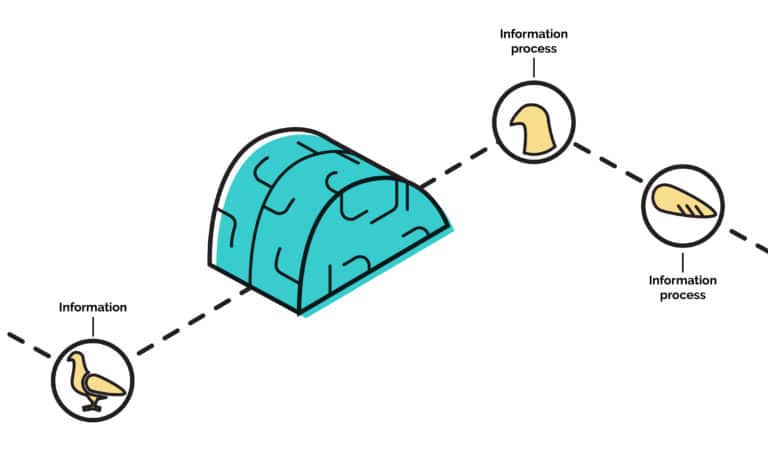
Also, as part of Gardner’s theory, he argues that it’s not how the information reaches our brain, but what matters is what our brain does with the information once it is received.
What Are the Gardner’s Multiple Intelligences?
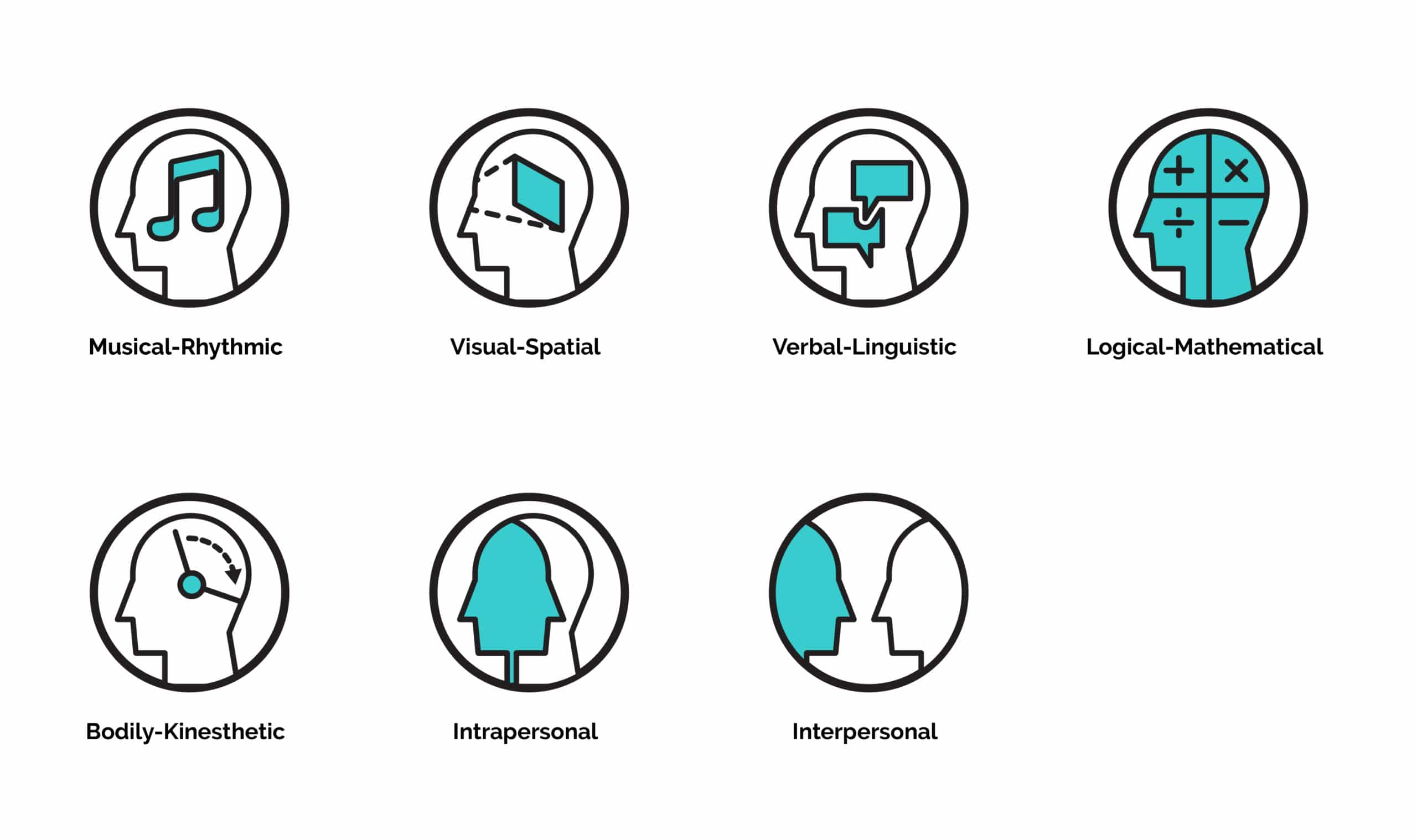
The eight different categories of Gardner’s multiple intelligences are:
Musical-Rhythmic
Visual-Spatial
Verbal-Linguistic
Logical-Mathematical
Bodily-Kinesthetic
Interpersonal
Intrapersonal
Naturalistic Intelligence
Musical-Rhythmic
Those with strong musical-rhythmic intelligence are really good at pinpointing patterns, especially among different types of sound. They often think in patterns and rhythms and tend to excel in musical composition and have the ability to play musical instruments really well. They also have a strong ability to remember songs and melodies.
Visual-Spatial
People with strong visual-spatial intelligence are really good at visualizing. They tend to have a good sense of direction and will likely succeed in marketing because of their ability to bring life to marketing messages through the use of visuals. Let’s say your brand conducts market research on the ways your customers use your product. A person with strong visual-spatial intelligence can take your market research and use it to build an effective infographic.
Those with this type of intelligence tend to enjoy writing and reading and are good at putting puzzles together. They also excel in being able to simplify complex information.
Verbal-Linguistic
A person with strong linguistic-verbal intelligence excels in writing and reading. They tend to use fancy words when writing and speaking and are really good at memorizing information, which makes them good at taking tests. If you have strong linguistic-verbal intelligence, you’re probably good at debating because of your ability to give persuasive speeches. Your persuasiveness capabilities, along with your ability to explain things really well, would make you a great marketer or lawyer.
Bodily-Kinesthetic
Those with strong bodily-kinesthetic intelligence are really good at physical activity because of their enhanced physical control capabilities. They usually excel in dancing and sports. They also tend to be hands-on and enjoy creating things. As far as memory recall, those with this intelligence tend to learn better by doing rather than hearing or seeing.
Interpersonal
If you empathize and relate with others really well, then you probably have strong interpersonal intelligence. You’re most likely really skilled at nonverbal communications, and you do well with understanding the intentions of those around you. Counselors, salespeople, politicians, and philosophers usually have strong interpersonal intelligence.
Intrapersonal
Those with strong intrapersonal intelligence do a lot of self-reflecting. They are extremely aware of their emotional state as well as what motivates them to behave the way they do. Characteristics of those with strong intrapersonal intelligence include daydreaming, assessing personal strengths, exploring theories, and always having a good understanding of why they feel a certain way.
Naturalistic Intelligence
Gardner’s multiple intelligences theory didn’t always include naturalistic intelligence. This intelligence category has endured much resistance from others. Those with strong naturalistic intelligence are said to be incredibly in tune with their surroundings and like exploring nature. They notice even the smallest of changes in their environment and have no desire to study topics that don’t relate to nature or what is going on around them.
Difference From Learning Styles
Over the years, Gardner’s multiple intelligences theory has become prized by teachers, many of whom have made the intelligences synonymous with learning styles. However, it’s important to note that multiple intelligences are not learning styles.
Gardner sought to set the record straight regarding learning styles and multiple intelligences when he said the following:
The Benefits of Gardner’s Multiple Intelligences Theory
Understanding Gardner’s multiple intelligences theory proves beneficial for a number of reasons. Imagine as a marketer that you analyze your buyer persona and determine that the majority of your customers have strong visual-spatial intelligence. Knowing this allows you to refine your marketing efforts accordingly. Instead of posting lengthy blog posts on certain topics, your audience would much rather look at an infographic or watch an explainer video covering the same information.
If you discover that the majority of your audience has strong naturalistic intelligence, then you know to position your marketing messages with an environmental angle. Let’s say you sell accounting software. To effectively connect with your audience, you could create marketing materials on the various ways that accounting software reduces paper waste, or how to go paperless.
Studying the theory of multiple intelligences is also important for business leaders for a number of reasons. It not only increases productivity within the work place by better communicating with employees, but it can also be used to better communicate your marketing message with your audience.
Connecting with your audience in a way that leads to higher conversions starts with understanding how they think and behave. Use our guide on the Gardner’s multiple intelligences theory to improve your visual marketing efforts. And don’t hesitate to reach out to us for help with using Gardner’s theory to boost your marketing efforts. As a visual marketing agency, we excel in helping brands connect with their customers based on their preferred marketing mediums.



 What Are the Gardner’s Multiple Intelligences?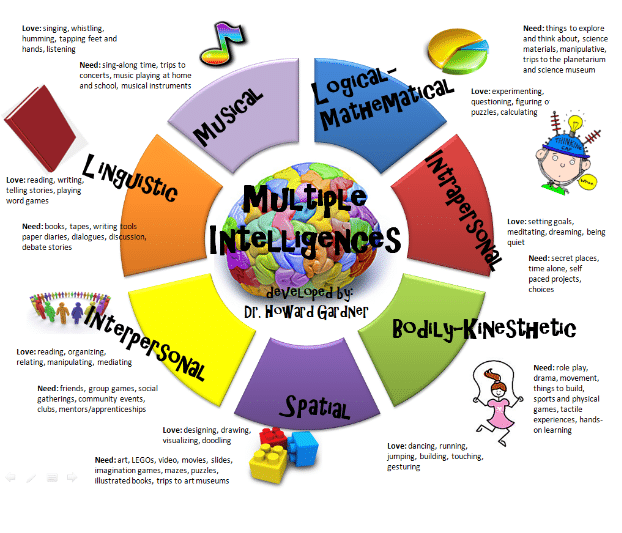
 Musical-Rhythmic